


 0

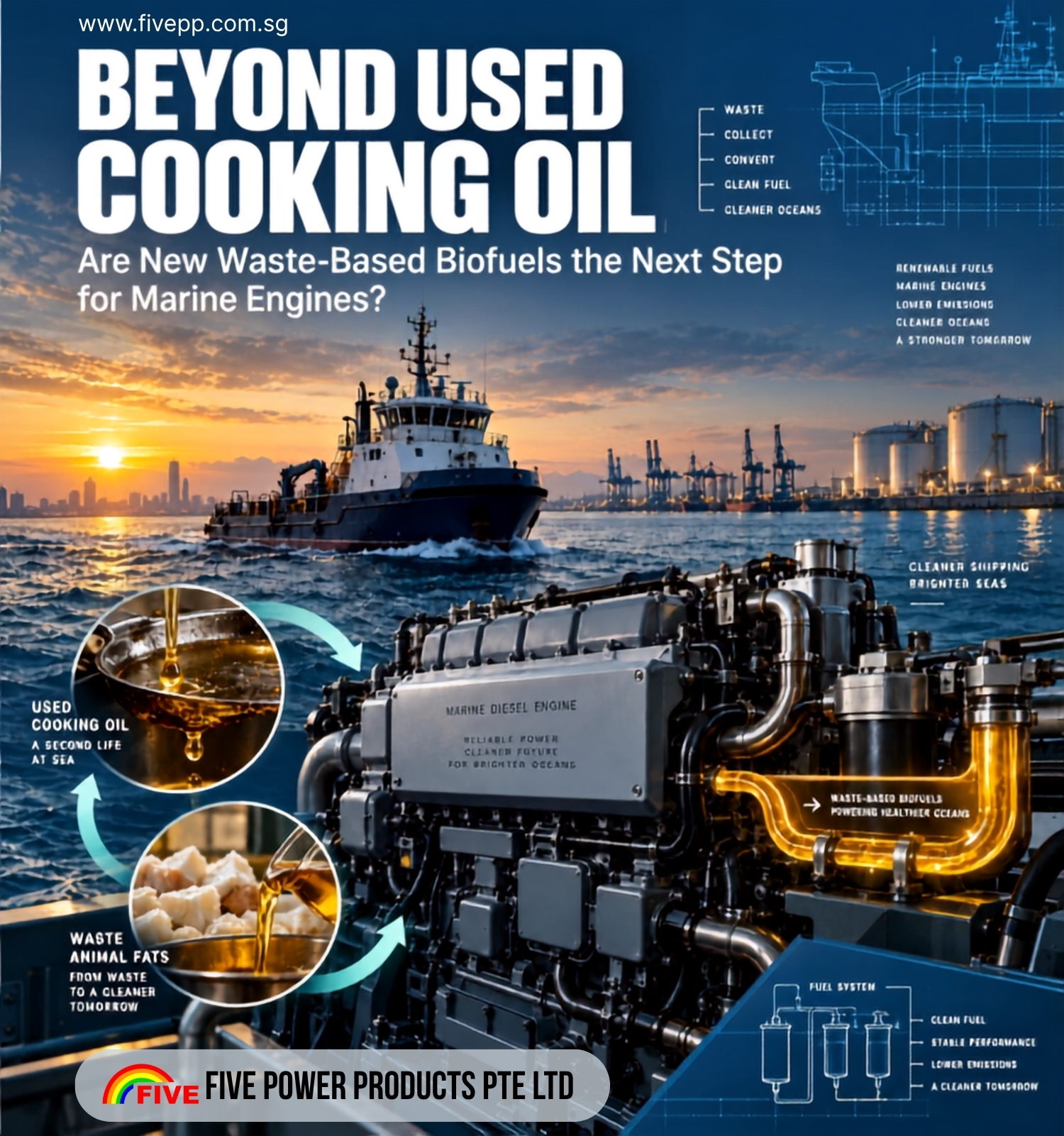
Beyond Used Cooking Oil: Are New Waste-Based Biofuels the Next Step for Marine Engines?
- by Five Power Products
- September 10, 2026
The maritime industry is under growing pressure to reduce greenhouse-gas emissions without compromising vessel reliability,
operating range or safety. Alternative fuels such as methanol, ammonia and hydrogen continue to attract attention, but many
of them require new engines, storage arrangements or major vessel modifications.
Biofuels offer a more immediate option. Some can be blended with conventional marine diesel or used as drop-in fuels,
depending on their specification and the engine manufacturer’s requirements. Hydrotreated vegetable oil (HVO) and fatty acid
methyl ester (FAME) biodiesel are already among the most established biofuel options in shipping. However, the conversation
is now moving beyond fuels derived mainly from used cooking oil.
Why the Industry Is Looking Beyond Used Cooking Oil
Used cooking oil has become a popular biofuel feedstock because it turns a waste material into useful energy and avoids
relying entirely on virgin vegetable oils. Nevertheless, its supply is limited. As demand from shipping, aviation and road
transport grows, depending too heavily on a single waste stream could create availability and cost challenges.
This is encouraging fuel producers and maritime organisations to investigate other waste materials, including waste animal
fats, agricultural residues and industrial by-products. Combining different feedstocks may help increase supply, improve
procurement flexibility and reduce dependence on one raw material.
In June 2026, BHP and Singapore’s Global Centre for Maritime Decarbonisation launched a pilot involving a B100 biofuel blend
produced from used cooking oil and waste animal fats. The fuel was introduced into an existing supply chain and used aboard
the Berge Lyngor, a bulk carrier transporting iron ore from Western Australia to China.
The pilot is significant not simply because another vessel is using biofuel. It is testing how fuels derived from two different
waste streams can be blended, supplied, traced and operated under real-world conditions using existing bunkering infrastructure.
What Is a Multi-Feedstock Biofuel?
A multi-feedstock biofuel is produced using more than one type of renewable or waste-derived raw material. In the 2026 pilot,
the blend combines fuel derived from used cooking oil with fuel derived from waste animal fats, also known as tallow.
The purpose is not simply to produce another biodiesel blend. Different feedstocks have different availability, cost, lifecycle
emissions and physical properties. A well-managed multi-feedstock approach could allow suppliers to choose a suitable
combination while maintaining the required fuel specification.
However, feedstocks cannot be substituted carelessly. The finished fuel must meet the applicable quality requirements, and its
behaviour during storage, transfer and combustion must be properly evaluated.
Potential Environmental Benefits
Biofuels are often described as low-carbon because the carbon released during combustion may be partly balanced by carbon
absorbed during the growth of their biological source. That does not mean every biofuel is automatically sustainable or carbon-
neutral.
Its genuine environmental performance depends on the complete supply chain, including:
- The source of the raw material
- Energy used in collection and processing
- Transportation and distribution
- Changes in land use, where relevant
- Fuel handling and onboard consumption
- The treatment of waste products and production by-products
This is why the maritime sector increasingly considers well-to-wake emissions rather than exhaust emissions alone. Well-to-
wake assessment covers the fuel’s journey from production to its final use aboard the vessel.
According to the BHP and GCMD project announcement, the trialled blend has the potential to reduce well-to-wake
greenhouse-gas emissions by approximately 79% per voyage compared with very-low-sulphur fuel oil. This is a project
estimate rather than a universal figure for all biofuels. Actual reductions will vary according to feedstock, production
pathway, transport distance, certification and vessel operation.
Compatibility is one of the main attractions of liquid marine biofuels. Certain products can be blended with conventional diesel
or used at high concentrations without the extensive modifications required by some alternative fuels.
However, “drop-in” should not be interpreted as “use without checking.” Compatibility can vary according to:
- Engine manufacturer and model
- Fuel-injection equipment
- Fuel standard and blend concentration
- Seal, gasket and hose materials
- Fuel age and storage conditions
- Ambient and fuel-storage temperatures
- Existing deposits inside tanks and fuel lines
Before changing fuel, operators should consult the engine manufacturer or authorised technical specialist. Fuel specifications,
warranty conditions and recommended maintenance procedures should be confirmed in advance. A controlled trial or gradual
transition may be appropriate for some vessels.
Operational Challenges to Consider
The 2026 multi-feedstock pilot is examining several issues that are directly relevant to vessel operators.
Fuel stability and oxidation
Some biodiesels can degrade through oxidation during extended storage. Degraded fuel may form acids, sludge or deposits
that affect tanks, filters and injection equipment. Storage duration, exposure to air, heat and moisture should therefore
be controlled.
Cold-flow performance and wax formation
Fuel derived from animal fats can have different cold-flow characteristics from fuel made solely from used cooking oil.
At lower temperatures, wax formation may restrict fuel flow or clog filters. Although Singapore has a warm climate, vessels
operating internationally may encounter significantly colder conditions.
Water and microbial growth
Water contamination is already a concern in conventional marine diesel systems. Certain biodiesel blends can retain more
moisture, creating conditions that encourage microbial growth at the fuel-and-water interface. Regular draining, inspection
and water-separator maintenance remain essential.
Cleaning effect and filter blockage
Biofuel blends may loosen deposits accumulated in tanks and fuel lines during previous diesel operation. This cleaning effect
can cause an initial increase in filter blockage. Operators may need closer filter monitoring and additional replacement
filters during the transition period.
Material compatibility
Higher biofuel concentrations may affect certain older seals, hoses, coatings or elastomers. A review of the vessel’s fuel
system can identify components that require replacement before prolonged operation.
Why Traceability Matters
Two fuels sold under the same general biofuel description may have very different carbon footprints. A product made from
verified waste material may provide a substantially different lifecycle result from one produced using crops associated with
land-use change.
Reliable documentation is therefore essential. Traceability allows owners, charterers and regulators to verify where the
feedstock came from, how the fuel was produced and whether the claimed emissions reduction is credible.
The International Maritime Organization’s lifecycle-assessment approach considers both upstream emissions—known as well-
to-tank—and emissions associated with onboard use, known as tank-to-wake. Together, these form the well-to-wake
calculation.
As marine decarbonisation requirements develop, fuel certification and lifecycle data are likely to become as important as
price and technical performance.
What Vessel Operators Should Check Before Switching
Before introducing HVO, FAME biodiesel or a new multi-feedstock blend, vessel owners and operators should consider the following steps:
- Obtain written confirmation of engine and fuel-system compatibility.
- Review the required fuel standard and request a certificate of quality.
- Check the approved blend concentration and warranty conditions.
- Inspect and, where necessary, clean storage tanks before bunkering.
- Assess seals, hoses, coatings and filtration equipment.
- Prepare additional filters for the initial operating period.
- Establish procedures for water monitoring and microbial control.
- Confirm the fuel’s storage-life and temperature requirements.
- Record fuel consumption, engine performance and maintenance observations.
- Verify the feedstock origin and lifecycle-emissions documentation.
Fuel suitability should always be assessed for the specific vessel rather than assumed from the general biofuel category.
What This Development Means for the Marine Industry
Multi-feedstock biofuels could help the maritime sector expand its supply of lower-emission fuels while continuing to use
much of its existing engine and bunkering infrastructure. This may be particularly valuable for vessels that are not ready
for a complete propulsion-system replacement.
They are not a solution without challenges. Fuel quality, limited sustainable feedstock, price, cold-flow behaviour, long-
term storage and credible certification all require careful management. Nevertheless, real-world pilots are helping the
industry move from theoretical potential to practical operating knowledge.
For vessel owners, the key message is straightforward: the future of marine biofuel will not be determined only by whether
an engine can burn it. Successful adoption will also depend on feedstock integrity, consistent fuel quality, proper onboard
preparation and reliable technical support.
Conclusion
HVO and used-cooking-oil biodiesel have demonstrated that lower-emission liquid fuels can play an important role in maritime
decarbonisation. The next stage may involve a broader range of waste materials blended to improve supply and flexibility.
The use of waste animal fats alongside used cooking oil is a promising development, but it must be supported by testing,
traceability and careful fuel-system management. As more operating data becomes available, marine businesses will be better
able to determine which blends deliver the right balance of emissions reduction, availability, cost and engine reliability.
Vessel owners considering a new fuel should verify compatibility with their engine manufacturer and obtain professional advice
before making the transition.
More info on our website: https://www.fivepp.com.sg/blogs/
Check our social media page: https://www.facebook.com/fiveab/
Recently View Article






message us
Need more information or assistance?
We are here to help.